Lymph Nodes
Anatomy
A lymph node is an organized collection of lymphoid tissue, through which the lymph passes on its way to returning to the blood. Lymph nodes are located at intervals along the lymphatic system. Several afferent lymph vessels bring in lymph, which percolates through the substance of the lymph node, and is drained out by an efferent lymph vessel.
Every lymph node is enclosed by a capsule of connective tissue from which trabeculae lead into the internal part with the functional tissue. Here, the lymph passes a filtering network and is in contact with lymphatic cells as macrophages. Lymph follicles are a dense collection of lymphocytes, the number, size and configuration of which change in accordance with the functional state of the lymph node. For example, the follicles expand significantly upon encountering a foreign antigen.
A lymph node consists of
- the cortex, where B-lymphocytes are augmented and differentiated
- the medulla, with strains of reticulum
- the intermediate zone, where T-lymphocytes from the thymus are augmented
The hilum is a depression on the surface of the lymph node, which makes the otherwise spherical or ovoid lymph node bean-shaped. The efferent lymph vessel directly emerges from the lymph node here. The arteries and veins supplying the lymph node with blood enter and exit through the hilum.
Lymph nodes are particularly numerous in the mediastinum in the chest, neck, pelvis, axilla (armpit), inguinal (groin) region, and in association with the blood vessels of the intestines.graphic: wikipedia
graphic:U.S. National Cancer Institute's Surveillance, Epidemiology and End Results (SEER) Program
Brain
Relay
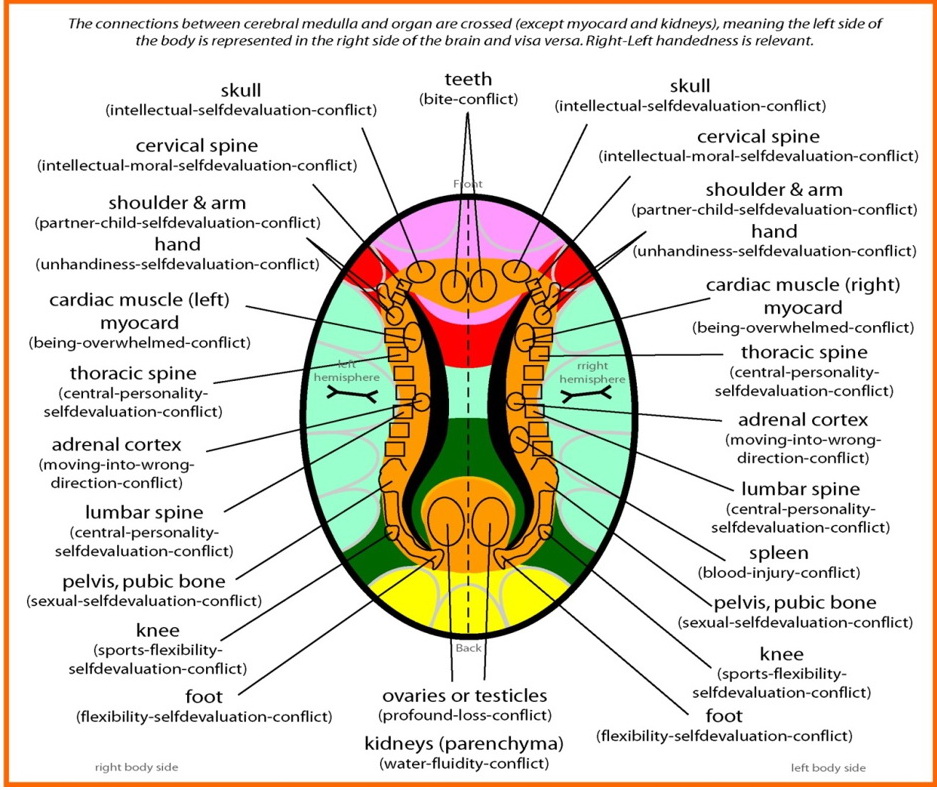
Cerebral Medulla ( – / + ) relay location according to body region
Mind
Theme:
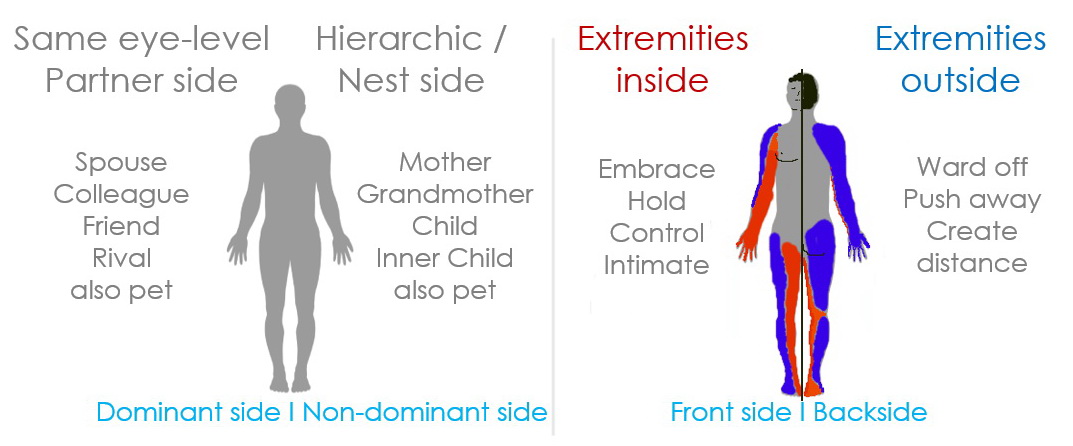
- Self devaluation regarding the affected area and it´s associations
- Self-sustainability and self-healing ability
Association according to locality:
For further associations see Skeletal System
Emotions, Thoughts
Self-doubt, self-hate, self-abandonment
- I doubt that I can handle that.
- I doubt that I can heal.
- I cannot forgive, and learn from that
- This part of me is useless
META-Meaning
- I handle everything life has for me fluently and with grace.
- Now, I can distinguish my resources from my ballast, and act accordingly.
- I love and accept myself as I am.
Organ
Stress Phase Symptoms
Functional decrease and later cell atrophy/necrosis in the lymph nodes. An immune deficiency could be diagnosed. Lymphedemas can occur as soon as there is functional loss or overexertion in enough lymph nodes of a drainage area. The edema will be localised distal from the non-functional nodes.
Regeneration Phase A
The regeneration phase is characterized by enlargement and swelling of the lymph nodes due to the replenishment of necroses through cell division
In case of the involvement of only one lymph node, there is an intense swelling (tumor) and pain (dolor). These swellings are often diagnosed as metastases, if there is another tumor in the body. Some of the other possible diagnoses are: Pfeiffer’s disease (infectious mononucleosis – possibly with additional conflicts involved in its development), Hodgkin’s disease (Hodgkin’s lymphoma), or lymphoblastic leukemia.
OBSERVE: In lymph nodes, we have to distinguish functional increase and swelling because of inflammatory processes in the area, showing that there is a yet unspecified regeneration phase or immunity (better: “integrity guarding” reaction) in progress, from the functional change and swelling during the regeneration phase of their own healing process. A functional increase on demand is a normal mechanism that can eventually lead to a conflict of the lymphatic system, in case that capacity limits are exceeded. Because of that, the conflict of lymphatics often follows other conflict cycles.
Healing Peak
Spasms of the lymph vessels and possibly stinging pain in the lymph nodes
Regeneration Phase B
The affected lymph nodes can be painful to touch.
After the process has been completed, the lymph nodes may remain slightly enlarged, but no longer painful.
Biological Meaning
The biological meaning in processes governed by the Cerebral Medulla lies in the finished regeneration phase. Lymph nodes will be enlarged and by the newfound health phase, more effective/alert than before.
Social
Examples
- The client is afraid that he can’t get rid of his prostate tumor. When he reaches a resolution, his pelvic lymph nodes swell painfully. Unfortunately, this was diagnosed as metastases by conventional medicine.
- Especially the local self-worth conflicts have a large importance now. For example: affected axillary lymph nodes in the case of breast cancer: „I’ve been hit in my self-esteem by breast cancer.”
- Children often experience this conflict in a holistic context (as a generalized problem), thereby we often see the simultaneous involvement of more than one lymph nodes at the different parts of the body.
Additional Information:
Lymphedemas can occur as soon as there is functional loss or overexertion in enough lymph nodes of a drainage area. This can happen in stress phase and in regeneration phase, for different reasons:
- The lymphatic system’s transport function is challenged when adjacent tissue shows inflammatory processes during regeneration.
- In stress phase of the lymphatic system itself, it’s functionality is impaired.
- In regeneration phase A by regular “healing oedema”
- After recurrences, when functionality is impaired through scarring and deformation.
The edema will be localised distal from the non-functional nodes. In combination with an active abandonment conflict Kidney Collecting Tubules), the edema can escalate into elephantiasis.
Differential diagnosis
Veins (Cerebral Medulla, -/+) vein insufficiency in the stress phase (feeling tied down) or after recurring conflicts can lead to edema and ulcus cruris, especially in the periphery.
Kidney Collecting Tubules (Brain Stem, +/-) stress phase causes water retention in the body by enhanced reabsorption of primary urine in the kidney, which usually enlarges other swelling processes.
Myocardium Right Ventricle (CM -/+) in stress phase (overwhelm regarding support) leads to backlog and oedema in feet & lower legs
In addition, malnutrition (protein deficiency) can lead to edema. Surgical lymphadenectomy or radiation can also lead to lymphedema.
Immune deficiency can be caused by functional loss or overexertion in any lymphoid tissue, as well as by medication, malnutrition, and radiation.