Blood Vessels – Coronary Arteries
Anatomy:
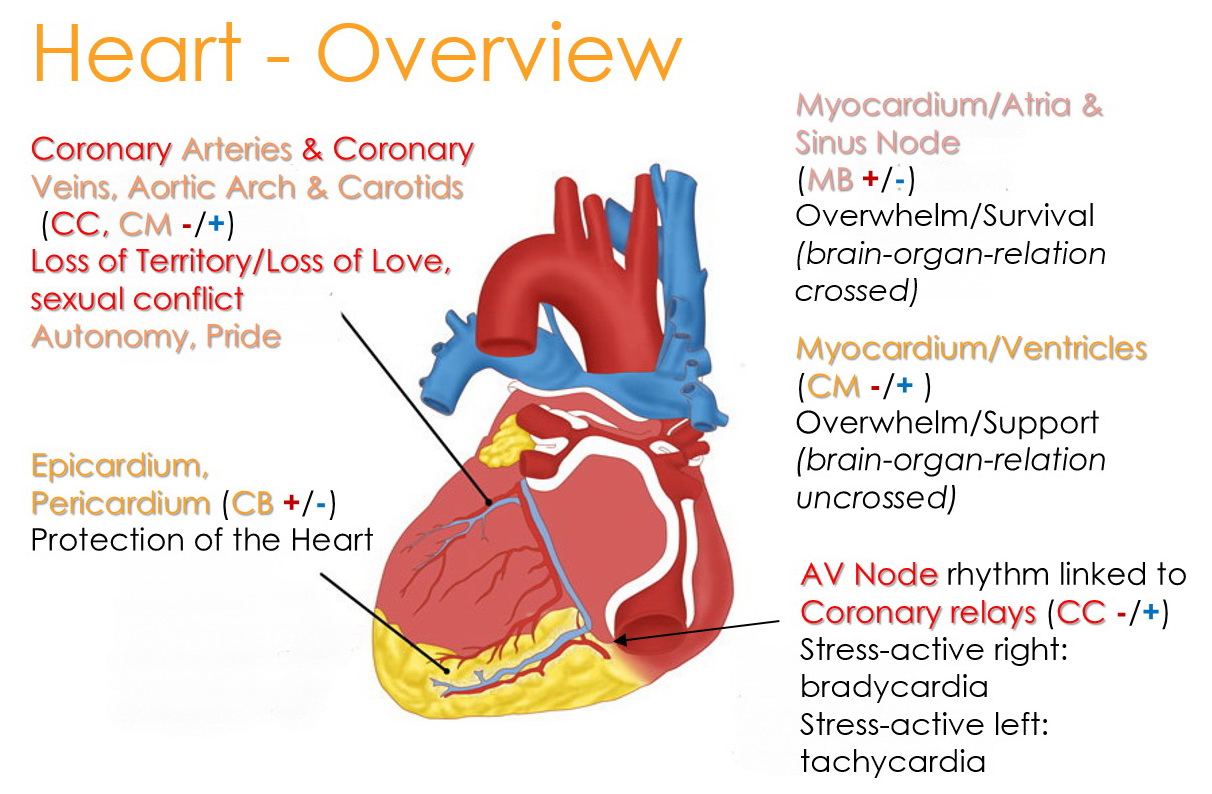
The coronary circulation is the circulation of blood in the blood vessels that supply blood to and from the heart muscle itself. Although blood fills the chambers of the heart, the muscle tissue of the heart or myocardium is so thick that it requires coronary blood vessels to deliver blood deep into it. The vessels that deliver oxygen-rich blood to the myocardium are known as coronary arteries. cardiac veins are vessels that remove the deoxygenated blood from the heart muscle. The coronary arteries that run on the surface of the heart are called epicardial coronary arteries. These arteries are capable of auto regulation to maintain coronary blood flow at levels appropriate to the needs of the heart muscle.
There are two main coronary arteries:
- The left main coronary artery supplies blood to the left ventricle and left atrium, the anterior part of the cardiac septum and part of the anterior wall of the right ventricle.
- The right main coronary artery supplies the right atrium and ventricle, the posterior part of the cardiac septum, the sinus and AV nodes, and part of the posterior wall of the left ventricle.
Additional arteries branch off the left main coronary artery to supply the left side of the heart muscle with blood. The coronary arteries that run deep within the myocardium are referred to as subendocardial. The coronary arteries are classified end circulation since they represent the only source of blood supply to the myocardium: there is very little redundant blood supply which is why blockage of these vessels can be critical.
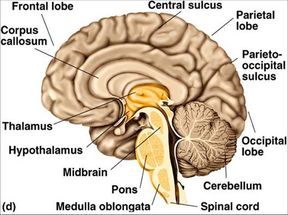
Brain
insular cortex, graphic: wikipedia, Henry Gray
Relay:
A) Cerebral Cortex/Plexus Cardiacus ( – / + ) for intima and AV node stimulation
Cut through cerebral cortex insular region, coronary arteries intima at “3 o´clock”
B ) Cerebral Medulla/Plexus Cardiacus ( – / + ) for vessel walls/connective tissueheart region in central area, brain-organ-relation uncrossed!
C) Midbrain/Plexus Cardiacus (+/0) for muscle layer
compare Brain Stemheart relay in central area, brain-organ relation crossed!
Mind
Theme
Conflict nuances:
A1) CC: Loss of territory/status (male perception): can be family-related, sexually-related or profession-related
A2) CC: Sexual frustration/not feeling loved (feminine perception) or sexual conflict
B ) MB: Supply for survival (blood-“chunk”-transport)
C) CM: Self-esteem, Autonomy, Pride
Emotions and Thoughts
A1) CC: Indignation, panic, hate
- My domain has been invaded.
- They took my place!
- I have to fight for my status!
- He stole my woman.
- It’s over for me.
- My life lost it’s meaning.
A2) CC: Jealousy or self-abandonment - I gave up my heart
- Why doesn’t he want me?
- You don’t love me anymore.
- My life has lost it’s meaning.
- I’m just a sex object for him.
- I am defiled.
B ) MB: Panic - The heart must get oxygen!
C) CM: Worry - Do I do enough for my heart?
- Can my heart do it?
META-Meaning
Now I can decide to open up for being free.
Now I can decide to open up for feeling the true meaning of love.
I totally love and accept myself as I am.
Organ
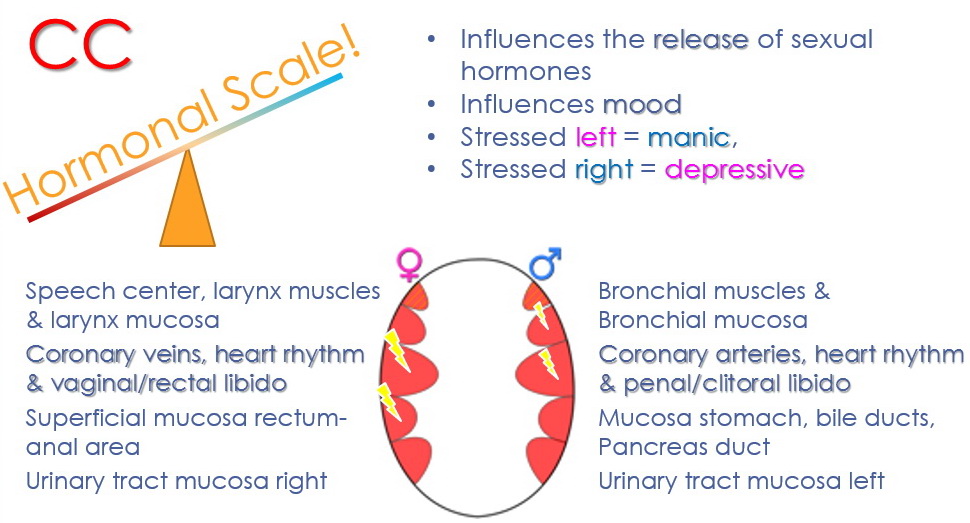
The brain relay is shared with the mucosa in prostate ducts, seminal vesicle & duct, as well as the penal and clitoral libido.
Sensitivity change - in coronary arteries according to IS with hyperesthesia in stress phase
- in seminal ducts and libido according to OS wth hyperesthesia in regeneration phase.
Stress Phase Symptoms
Elevated blood flow and pressure due to smooth muscle relaxation in the coronary arteries, possibly followed by ulceration of the intima of the vessel walls. Typical symptoms are shooting heart pain, chest tightness (angina pectoris) and possibly a depressive state (see constellations). Bradycardia and extrasystoles are possible
In case of a sexuality-related theme, testosterone level decreases which leads to indecisiveness and depressive states. Simultaneously in men, ulcers can appear in seminal gland intima or prostate duct, which affects the potency and fertility of the man. Depending on the conflict’s intensity the patient may experience erectile dysfunction, infertility or other disorders of potency. The penal excitability (clitoral in women) is reduced.
Regeneration Phase A
Typical symptoms are a painless swelling of the intima of the coronary arteries (stricture of the arteries /stenosis), and a cerebral periinsular edema in regeneration phase A. The tissue repair uses cholesterol, therefore elevated levels appear. Due to the development of collateral coronary circulation by anastomose, the blood supply of the heart can usually be maintained. Source .
Healing Peak
The healing peak, which happens latest 3-6 weeks after conflict resolution, can show bradycardia possibly up to cardiac arrest, together with loss of consciousness, dizziness, heart pain, headache and loss of balance. Nevertheless, in cases of lower impact it often goes unnoticed!
The main reason for these type of heart attack symptoms is the edema in the peri-insular area of the brain being “squeezed out” in the healing crisis. Due to brain regulation, there is a higher incidence of cardiac dysrhythmias (ventricular escape rhythm, bradycardia, sinus arrhythmia, under certain circumstances cardioplegia).The smooth muscles in coronary arteries often react with seizures. Patients often experience suspended animation with ca. 3-4 beats/minute and shallow breathing.
Regeneration Phase B
After the healing peak, ventricular frequency normalizes and the damages to vessel walls repair with scar tissue. The scarring of coronary arteries through recurring conflicts can intensify the symptoms of angina pectoris
Biological Meaning
Dilatation and muscle tonus of the coronary arteries during the stress phase are meant to provide better blood supply for the myocardium, and thereby better performance of the organism to re-gain his territory.
It is obvious that these changes are meant for a short duration or an emergency situation. The organism is not cut out for permanent high performance. Therefore, these reactions cannot be sustainable strategies!.
Examples
Loss of territory/status:
- The wife separates from the man (possibly she has another lover)
- A dismissal from work
- Having a new supervisor at work
- Formerly, there was only one family physician in the village, but now, there are two more doctors. Depending on the individual’s personality, it can be experienced as an existential angst.
Sexual frustration conflict or loss of love: - Parents tell their child that he was an unwanted baby
- A woman has been raped throughout her childhood. She later has nymphomanic tendencies but gets no children of her own. (Klapp)
- A woman is left by her lover for another woman. Her heart symptoms trigger worry about her health, resulting in pericardium reactions. (Klapp)
Additional Information
Warning: When this type of conflict is constantly stress-active during more than 9 months, the conflict mass might be so big that the healing peak may kill the person. This is often prevented by adopting a territorial constellation (see below) which keeps the conflict mass (and physical symptoms) on a lower level.
Possible Constellations
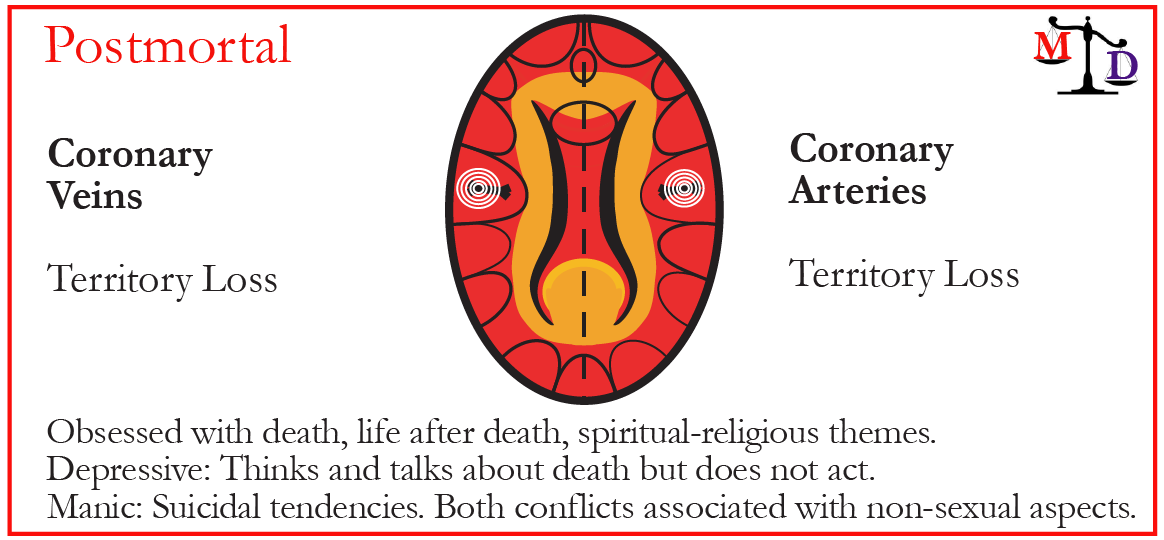
Death-Seeking: together with Coronary Veins relay. Interest in death and afterlife. Fearlessness, giving oneself up for a greater purpose. Suicidal thoughts and risk of suicide in mania. Positive: Unconditional love
If together with aggressive constellation, possibly suicidal assassin.
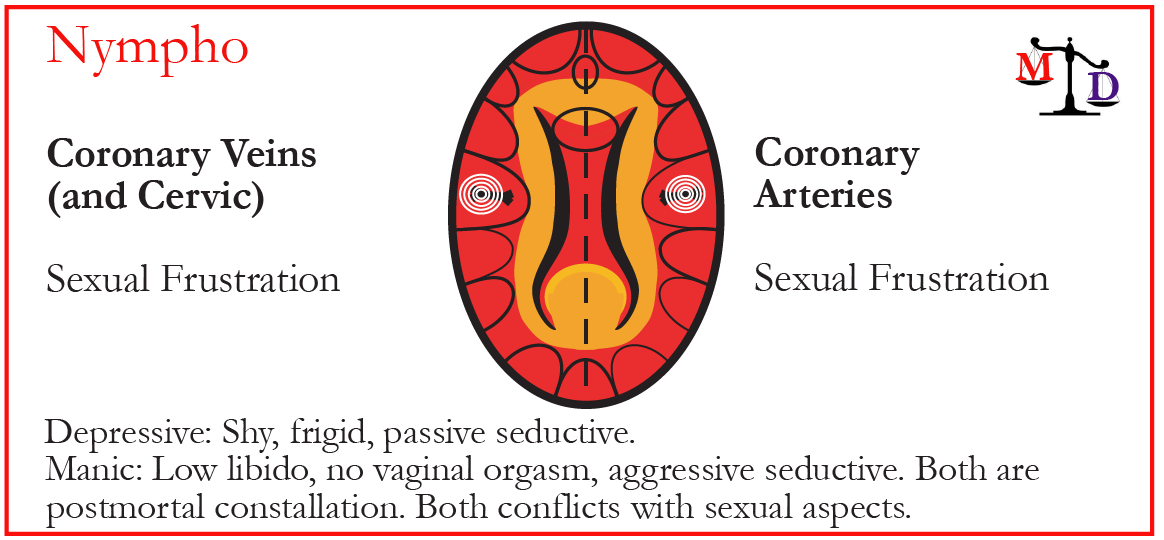
Nymphomania: together with Coronary Veins relay, if both conflicts had a sexual theme. Flirting and constant attraction of transitory lovers. Frigidity and often reduced potency.Positive: Unconditional love.
These schizophrenic constellations show manic, depressive or bipolar moods, depending on conflict impact and hormone affection: - impact left hemisphere= reduced oestrogen release, mania;
- impact right hemisphere: reduced androgen release, depression
Differentiation of coronary heart disease and myocardial infarction
The coronary vessels supply the cardiac muscle and thereby influence it’s reaction. Therefore, in long-termed territorial loss conflicts, the heart muscle will be weakened. However, there are myocardial infarctions that show no obstruction of blood vessels. These are due only to overwhelm and performance regarding supporting another person (compassion). A myocardial infarction of the right heart leads to spontaneous elevation of blood pressure by compensatory mechanism. When the left heart is affected, blood pressure falls. In a coronary infarction, blood pressure does not change obviously.
Myocardial changes may result in the development of heart insufficiency.
Differential Diagnosis:
Coronary Veins (Cerebral Cortex, Plexus Cardiacus, -/+) with painful angina pectoris in the stress phase (loss of love/rank); and absence, tachycardia or ventricular fibrillation in the regeneration phase
Endocardium (Cerebral Medulla, Plexus Cardiacus, -/+) with reduced heart performance due to valve insufficiency in stress phase (performance self-devaluation), painful endocarditis in regeneration phase
Myocardium/Ventricular (Cerebral Medulla, Plexus Cardiacus, -/+) with reduced heart performance due to local paralysis in the stress phase (overwhelm/support), myocardium infarction in healing peak
Myocardium/Atrium(Midbrain, Plexus Cardiacus, +/0) with atrial tachycardia and fibrillation in regeneration phase (after overwhelm/survival)
Pericardium (Cerebellum, Plexus Cardiacus, +/-) with feeling of pressure or “armored heart” in stress phase (protection of the heart), cardiac insufficiency due to effusion in regeneration phase