Larynx – Muscle
Anatomy
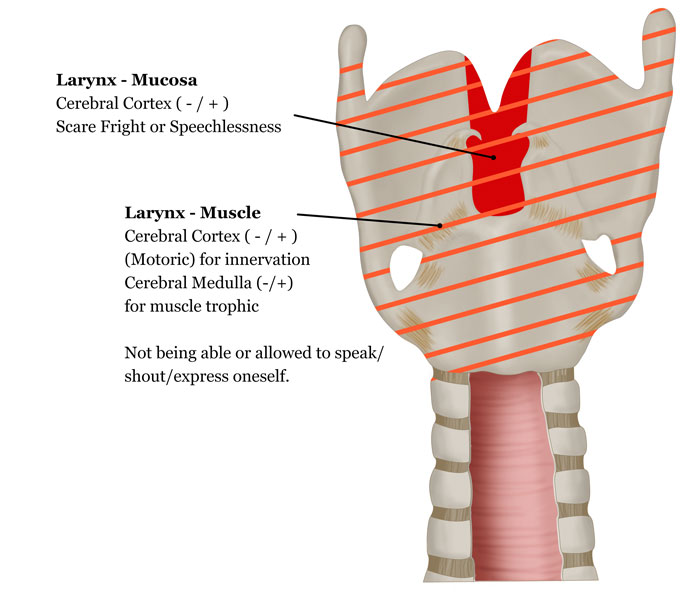
The larynx or voice box is an organ in the neck involved in protection of the trachea and sound production. The larynx houses the vocal folds and is situated just below where the tract of the pharynx splits into the trachea and the esophagus. Vocal cords are integral parts of the vocal apparatus, making it possible to speak.
- Cricothyroid muscle lengthens and stretches the vocal cords.
- Posterior cricoarytenoid muscle abducts the vocal cords.
- Lateral cricoarytenoid muscle adducts the vocal cords.
- Thyroarytenoid muscle (also called vocalis muscle) shortens vocal cords.
- Transverse arytenoid muscle adducts the vocal folds.
Notably the only muscle capable of separating the vocal cords for normal breathing is the posterior cricoarytenoid. If this muscle is incapacitated on both sides the inability to pull the vocal cords apart (abduct) will cause difficulty breathing. Bilateral injury to the recurrent laryngeal nerve would cause this condition.graphic: wikipedia, Olek Remesz
The recurrent laryngeal nerve (part of vagus, 10th Cranial Nerve) provides the motor innervation of all intrinsic laryngeal muscles except the cricothyroid muscle. Laryngeal muscles (musculi laryngis) are responsible for controlling the movements of the vocal cords, therefore they are able to regulate the opened or closed status of the glottis. Thereby these muscles can control the way of exhaled air from the lungs to outside, and the way of inhaled air from outside to the lungs. In the relaxed condition of laryngeal muscles, the glottis is widely opened so the inhaled air can easily flow through.
The larynx muscles are essential for the Social Engagement System (SES) for stress relief (see Polyvagal Theory).
Brain
graphic: wikipedia Taken from NIH publication 97-4257, http://www.nidcd.nih.gov/health/voice/pages/aphasia.aspx
Relay:
1. Cerebral (Motor-) Cortex, Broca speech centre and Vagus ( – / + ) for innervation
Insular cortex, motor relay in “11 o´clock”
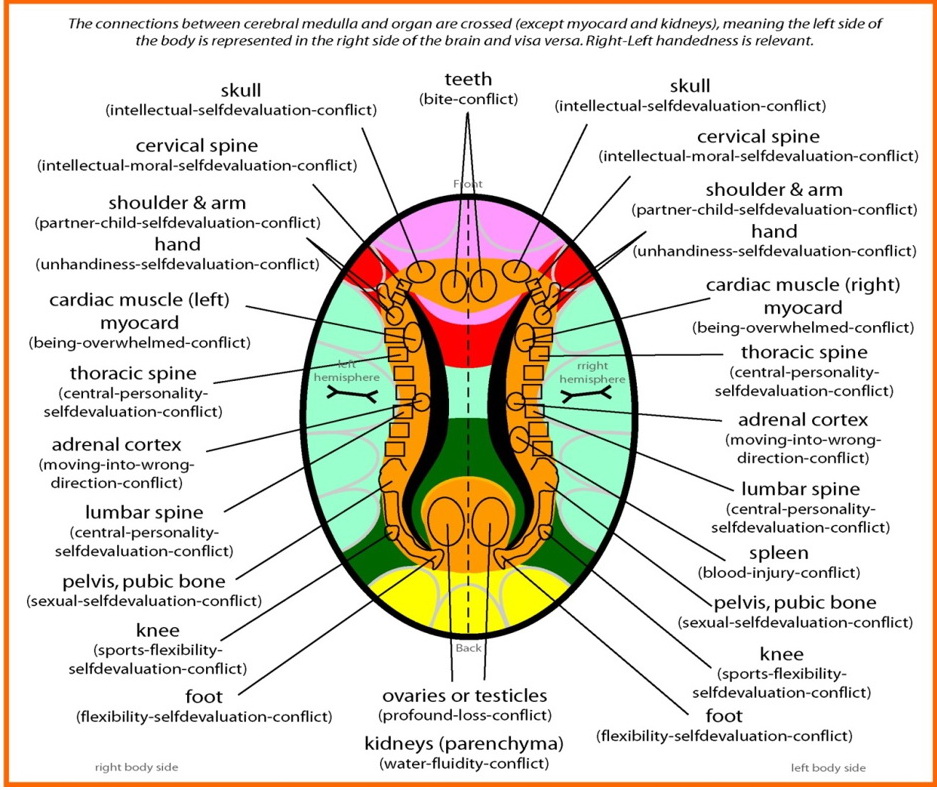
2. Cerebral Medulla (-/+) region for mouth & skull (for muscle trophic)
Mind
Theme:
1. (CC) Not being able or allowed to speak/shout/express oneself.
2. (CM) Self-devaluation because of speaking/self-expression performance
The laryngeal muscles often react together with the larynx mucosa in a scare-fright, speechlessness or territorial fear conflict.
Emotions, Thoughts:
1. (CC) Social fear, inhibition, suppressed anger
- Why don´t you let me have a say?
- I must be silent.
- They don’t let me speak!
2. (CM) Anxiety, self-doubt, frustration - Why can´t I utter a sound?
- I can’t make my voice heard
- My voice is no good.
META-Meaning:
- Now I decide for myself, when and how loud I speak!
- Now, I express myself freely and easily.
Organ
The motoric function of the muscles (voice, breathing) is immediately influenced by stress, while processes governed by the cerebral medulla lead to successive decrease in tissue and function.
Stress Phase Symptoms:
Feeling of breathlessness, recurrent laryngeal nerve paresis, motor paralysis of laryngeal muscles leading to stammering or muteness, possibly accompanied by laryngeal muscle necrosis. The recurrent laryngeal paralysis could be a symptom of stroke (hemorrhagic stroke).
Regeneration Phase A
The innervation of voice box (through the recurrent laryngeal nerve) slowly returns, which again can lead to stammering/stuttering.
When the larynx mucosa is triggered, hyperesthesia effects a dry barking cough.
Healing peak:
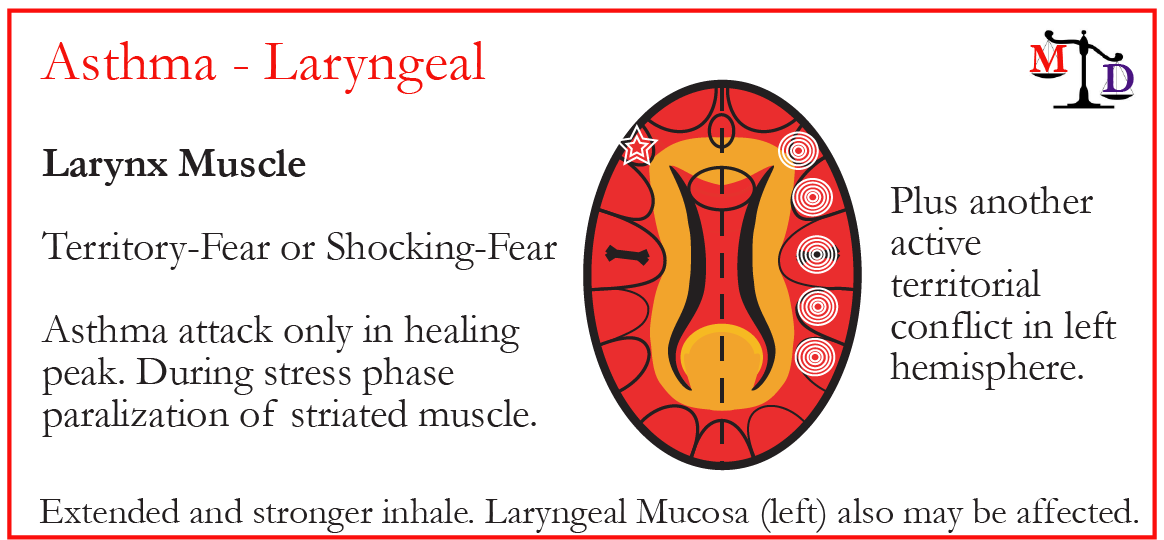
Difficult and prolonged inhale, which can result in gasping breathing. Inspiratory laryngospasm (vocal cord dysfunction) may also occur. Another potential symptom is the shortness of breath after coughing spells.
When the larynx mucosa reacts together with the muscle, numbness and absence (unconsciousness) appears during the healing peak, accompanied by a drop of blood sugar.
Regeneration Phase B
Muscle weakening/necrosis is repaired to leave the muscle stronger after completed regeneration.
Biological Meaning:
Due to the paralysis (or relaxation) of the laryngeal muscles in a frightening situation, the larynx tissues get expanded. It results in an immediate increase in the amount of air flowing into the lungs.
Social
Examples
- A girl started to stammer after she had been visiting a befriended family where there was sexual abuse, which she couldn’t tell her mother. (Klapp)
- A client experiences fear and stress triggered by her lifestyle. She gets coughing and gasping spells during and after her work with clients, and when singing: both stress- and regeneration triggers can bring up the symptoms. (Klapp)
Additional Information
The only muscle separating the vocal folds in breathing is the posterior cricoarytenoid. When this muscle is dysfunctional on both sides, breathing is impaired.
Possible Constellations:
Laryngeal Asthma appears simultaneously with a conflict activity of another brain relay in the right periinsular cerebral cortex (sexual, social and territorial relays). Often the larynx mucosa and muscle co-react in a motoric-sensory combination with numbness and paralysis in the stress phase, and laryngeal spasms, numbness and possibly absence during the healing peak.
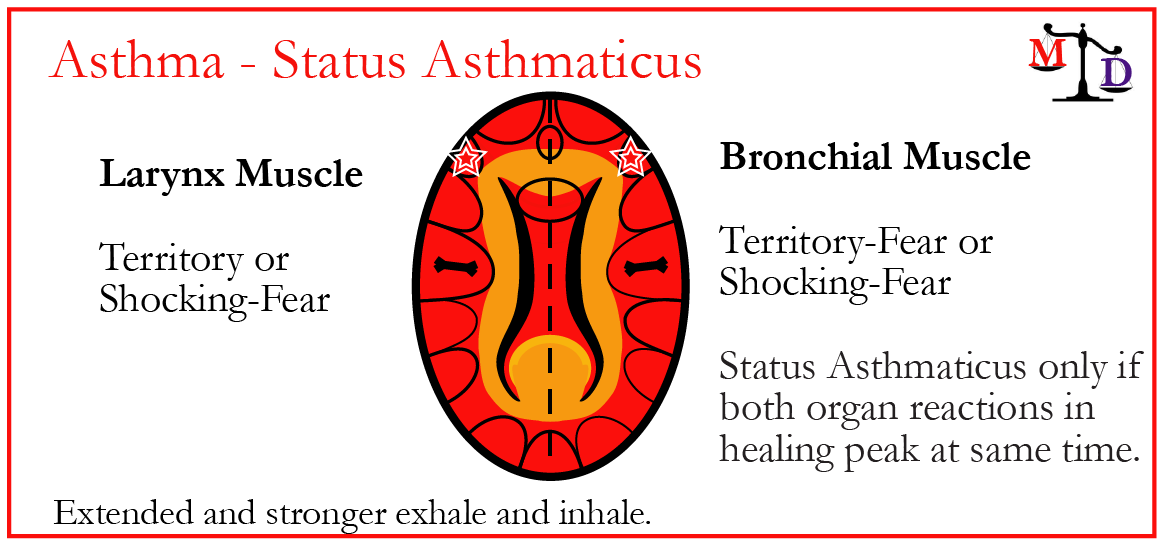
Status Asthmaticus occurs when the laryngeal muscles and the bronchial muscles come into healing peak simultaneously. Main symptoms are extreme wheezing, angina pectoris and double seizures after paresis/paralysis of the striated muscle. Intensified use of auxiliary respiratory muscles. Status asthmaticus requires emergency treatment.
Differential Diagnosis:
Larynx Mucosa (Cerebral Cortex, -/+) Stress (fright, social fear): manic states, perhaps apnea; Regeneration: laryngitis, hypersensitivity and dry cough from the voice box area, often depressive states
Facial paralysis (Cerebral Cortex, -/+) in the stress phase (losing face) can also influence speech.