
Auditory System
Anatomical and functional overview
The auditory system is the sensory system for the sense of hearing. It includes both the sensory organs (the ears) and the auditory parts of the sensory system.
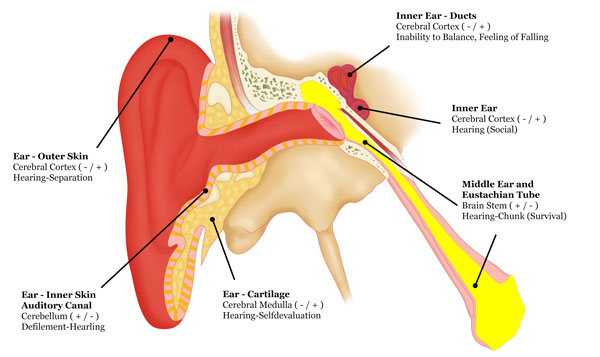
The outer ear is the external portion of the ear, which consists of the auricle (the folds of cartilage surrounding the ear canal are called pinna) and the external ear canal covered in skin (epidermis and dermis). It gathers and reflects sound energy and focuses it on the eardrum. When reaching the the tympanic cavity, the sound waves have been amplified 30- to 100-fold in the range of frequencies from 3 to 12 kHz, which makes humans especially sensitive to these frequencies.
The eardrum separates the outer from the middle ear. In the air-filled tympanic cavity, a series of ossicles transfer and convert the sound to higher pressure. The stapedius muscle is by reflex activated to protect the inner ear, reducing the transmission of sound energy.The Eustachian tube connects the ear to the nasopharynx.
While the middle ear still contains the sound information in wave form; it is converted to nerve impulses in the cochlea of the inner ear. The electrochemical impulses are then passed on to the brain via the auditory nerve.
The inner ear also contains the vestibular system which works together with the visual system to keep objects in focus when the head is moving, thus creating the perception of balance necessary for coordination.
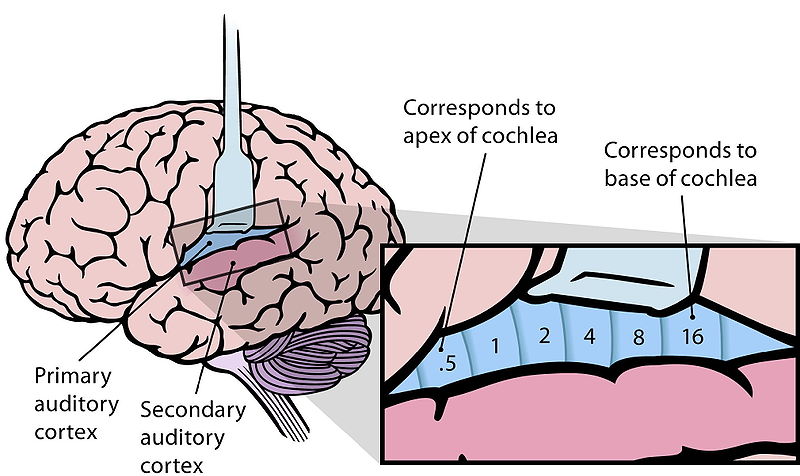
The auditory nerve leads the sound information on to be processed in the brainstem, the midbrain, and the thalamus, from where it is relayed to the temporal lobe in the cerebral cortex (temporal lobe, Wernicke-speech centre).
Brain
Relays
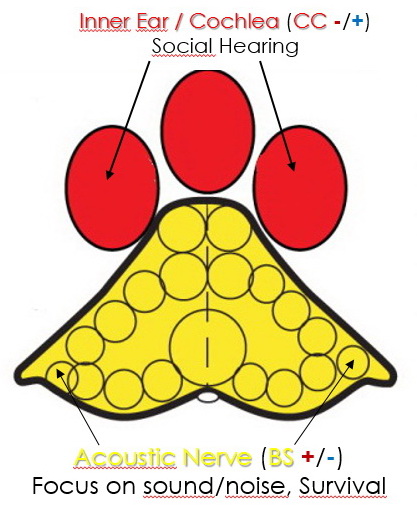
- Nuclei of the acoustic nerve: Brain Stem lateral left & right at the junction of pons & cerebellum, brain-organ relation uncrossed
- Cerebral Cortex: relay of the cochlea in baso-temporal postsensory area, caudal (below) the insula. Accordingly, territorial conflicts usually are maintained by auditory triggers (pitch & rhythm of voice). Brain-organ-relation crossed over.
META-Organ Tissues
- Outer Ear Skin
- Middle Ear – Tympanic Cavity and Eustachian Tube (BS +/-): “Auditory Chunk” or “prey-hearing”: the need to get or get rid of auditory information
- Middle Ear – Ossicles & Muscles (CM -/+): Sound management
- Inner Ear – Cochlea – Hearing (CC -/+): Speech recognition and sound evaluation
- Inner Ear – Vestibular System (CC -/+): Equilibrium, control (fear to fall)
