Nerves and Nerve Systems
Anatomy
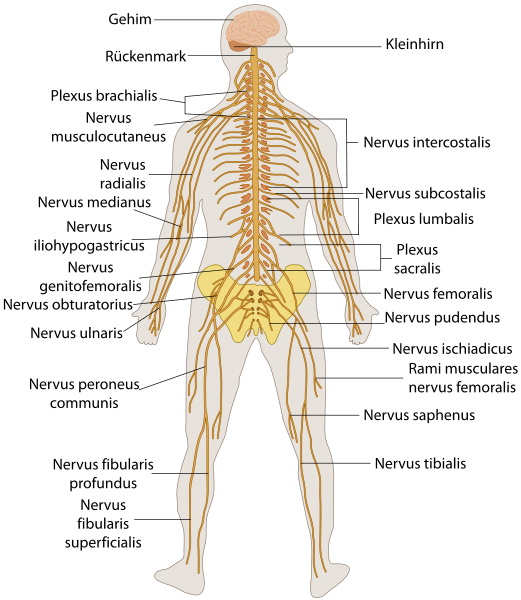
Nerves receive and transmit electric impulses for steering and coordination of vital functions.
They pervade the whole body as a tree with branches, whose stem is situated in the brain and spinal cord.
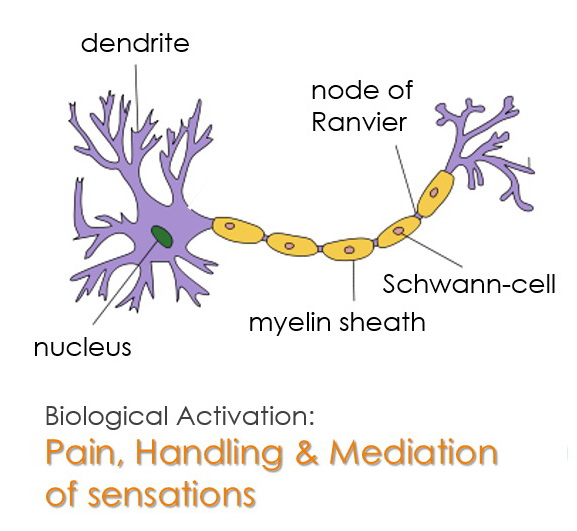
Nerves consist of several fibres (neurons), each with a cell body (soma), nucleus, dendrites for stimuli reception and an axon for transmission. The axons of most nerves possess a myelin sheath of glia cells. At the end of an axon, the contact to other nerve cells or tissues is made by synapses, as in the myoneural junctions in muscle fibres.
The bridge between nerve- and homonal systems are the hypothalamus and pituitary in the brain.
Nerve systems
By function and mode of operation, we distinguish:
1. The Autonomous Nerve System (ANS) which steers the involuntary rhythms, reactions and adaptions of the organs. It is divided into
- the activating sympathetic nerve system, whose impulses enable fight or flight responses
- the inhibiting parasympathetic nerve sysem, that dominates in relaxation and regeneration but also in freeze reflexes (UDIN).
- the enteric nerve sysem or “gut brain” of the intestinal tract, which is influenced by the sympathetic and parasympathetic branches.
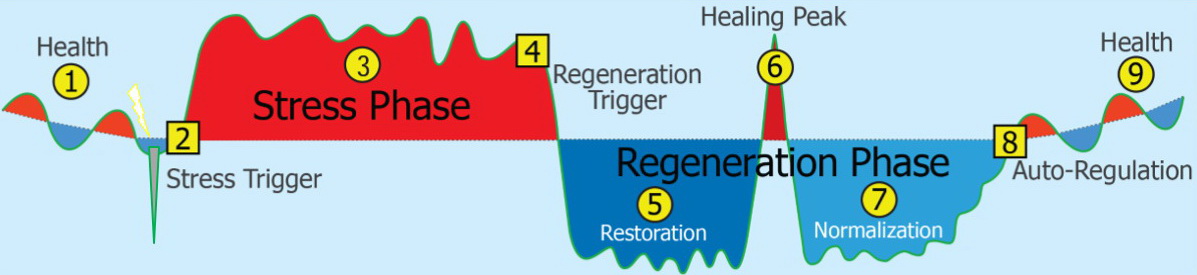
The Autonomous Nerve System effects our wake and sleep cycles, activity, rest and regeneration. The META-Health Phases Model is largely based upon the responses of the Autonomous Nervous System.
2. The somatic or cerebrospinal nerve system guides the perception of external stimuli (the sensory input) and the voluntary functions (the motoric output). By location we distinguish - the central nerve system (CNS) consisting of brain and spinal cord
- the peripheral nerve system begins where the nerves leave the spinal canal.
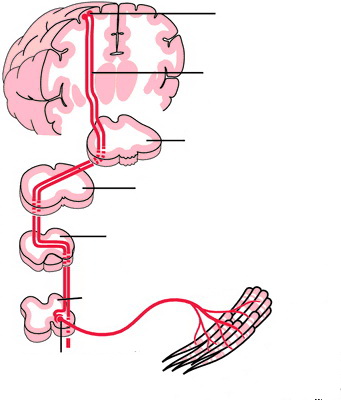
Afferent neural pathways (leading towards the brain) transmit sensory perceptions for processing, while efferent pathways run from the brain towards effecting organs, like the motoric nerves run to muscles.
META-Organ Tissues:
Brain Overview
Brain – Meninges(CB +/- and CC-/+): Protection of Brain and Beliefs
Myelin Sheath of nerves (CB +/-): Fear of Contact, Fear of Pain
Sensory Innervation (CC -/+): not wanting, being able, or allowed to Feel / Perceive
Motoric Innervation (CC -/+): Paralyzing Trauma or Physical Overload
Details of Facial Nerve
Details of Trigeminus Nerve